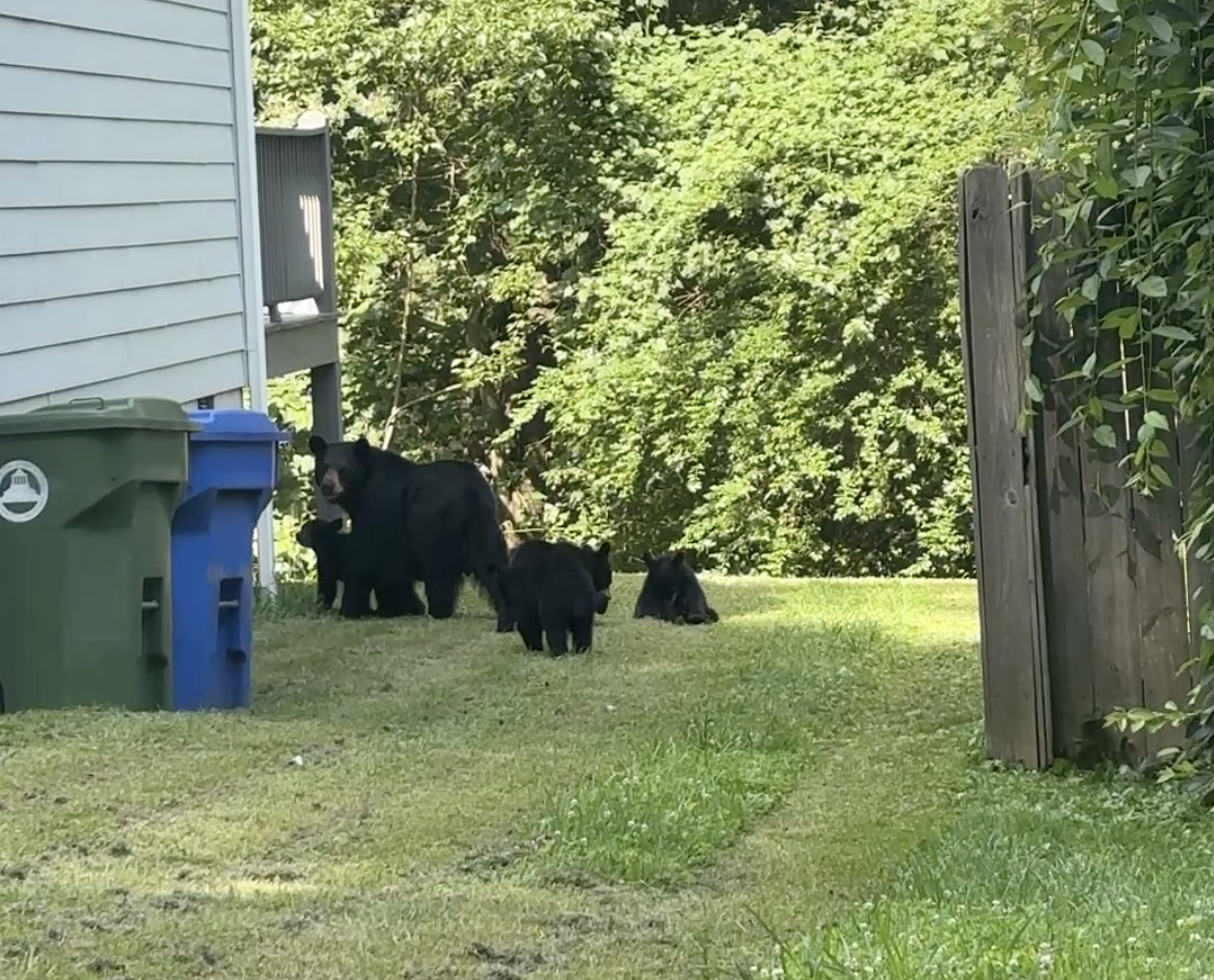
ASHEVILLE, N.C. (828newsNOW) — The North Carolina Wildlife Resources Commission is still looking for a female bear that injured an Asheville resident during a home break-in last month. The bear has since attempted several more forcible home entries.
Around Tuesday, Aug. 18, 2026, the bear entered two homes within a 24-hour period and attempted to enter another. During one of the break-ins, the bear injured a resident who was attempting to give the bear an escape route out of the house.
Following the injury, the NCWRC has sought to capture the bear to humanely dispatch her, though have been unsuccessful so far. Last weekend, Aug. 29-30, 2026, the bear attempted to enter a fourth home in the same neighborhood, and the NCWRC suspects she was involved in a fifth attempt.
The bear has been identifiable because of her unique markings, as well as her repeated pattern of break-in behavior.
“She is not afraid of people, causing extensive property damage, and has forcibly entered homes of residents that have no evidence of unsecured trash or other unsecured attractants outdoors. She has learned that all homes have food inside,” the NCWRC said. “This bear not only poses a risk to human safety, but she is teaching her cubs the same dangerous and unnatural behavior.”
Meanwhile, two of the bear’s cubs have been caught.
“As of Sept. 1, staff have not captured the adult female bear but continue to monitor the situation. Staff were successful at capturing two of her cubs. The cubs were assessed and determined to be at a weight and age to be self-sufficient on their own. They were moved and released in an undeveloped area where they can thrive and grow up to be wild black bears,” said Mountain Operations Supervisor, James Tomberlin.
Tomberlin said that moving the cubs disrupts a generational behavior cycle of adult female bears teaching cubs to depend on humans for food. Moving cubs to an undeveloped region allows the animals to adapt to living in the wild before they learn to break into human homes.
What will happen to the bear when she is caught?
The NCWRC said that it is too late to reverse the behavior of the break-in bear, and that she must be captured and dispatched because of the threat she shows to human safety.
“Moving adult bears is not an option because it has been shown through research to be an ineffective solution,” the NCWRC explained. “Translocating a bear (moving it out of its home range) only moves the bear’s learned behavioral issues to another location. Moved bears often attempt to return to their home range and original site of capture. These bears are sometimes successful and revert to their learned, dangerous behavior. But most that attempt to return often do not make it as they die along the way (e.g., vehicle collision).”
The NCWRC attempted to implement non-lethal dissuasion tactics for the bear in the neighborhood, but said that it was too late because the bear had learned that food can be found around all human homes.
What should Asheville residents do if they see a bear?
The NCWRC encouraged Asheville residents to practice bear safety tactics.
“While it is too late to reverse this adult female’s dangerous behavior, it is not too late to prevent other bears from becoming habituated to humans and conditioned to eat unnatural foods, such as pet food, unsecured garbage and bird seed,” the NCWRC said.
The organization suggested that residents should secure those outdoor bear attractants – pet food, garbage and bird seed – advocate against intentional bear-feeding in their community and neighborhood meetings and invest in bear-resistant trash cans.
Bear-proof trash cans are no longer available from the city, but NCWRC advocated for their re-implementation.
“This option for city residents was removed due to funding,” the organization said. “Ideally, the city would make bear-resistant carts the standard cart for everyone.”
The NCWRC said that residents should also learn the BearWise Basics, a set of rules for safely co-existing with black bears.
Related reporting: