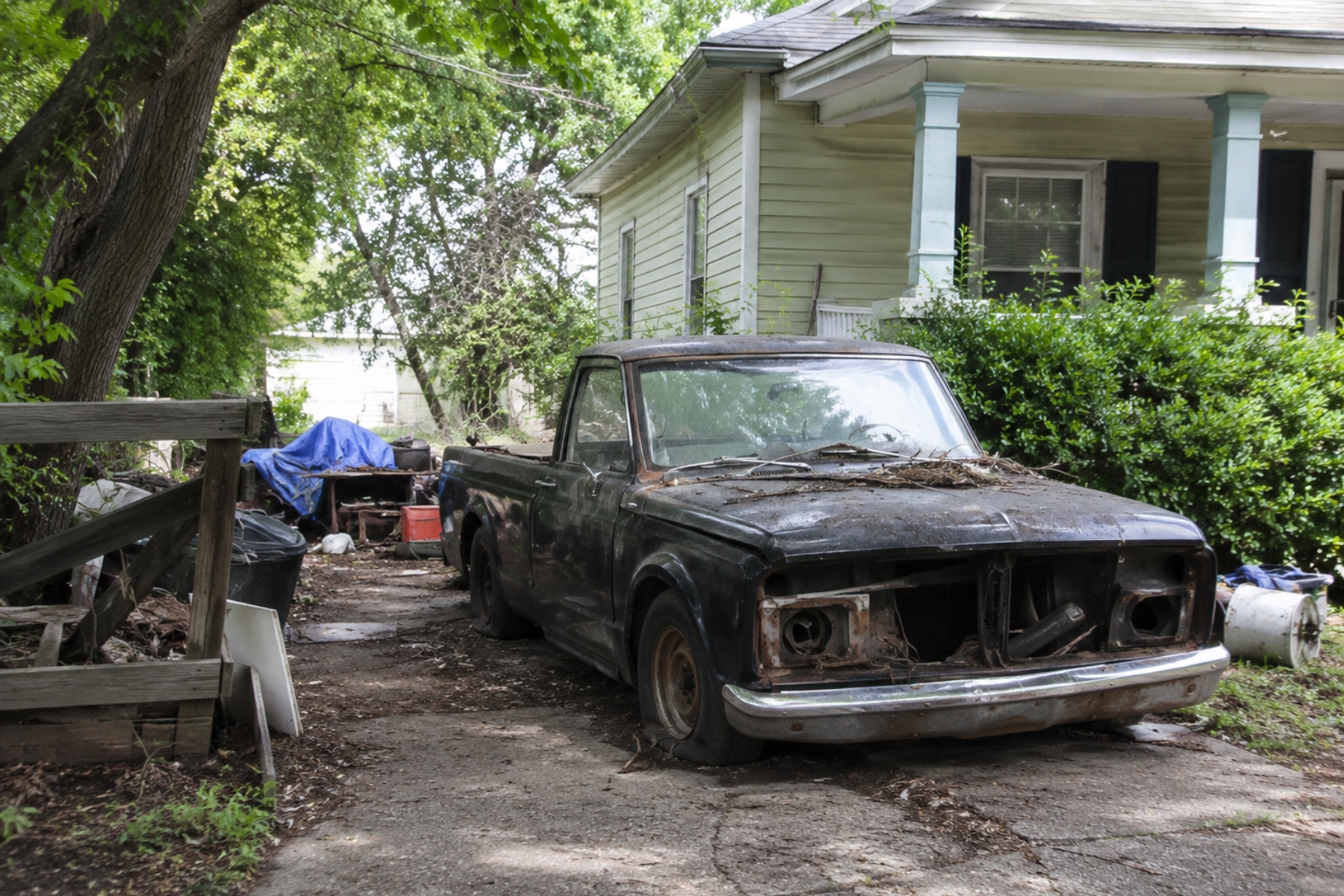
ASHEVILLE, N.C. (828newsNOW) — An old boat collecting rainwater. A pickup truck stuffed with trash. A rusted car with no tires that’s been sitting in the same yard for years.
Those are the kinds of problem vehicles Asheville officials say they’re trying to target with a proposed ordinance change that would make it easier for the city to address junk vehicles that have become public health or sanitation hazards.
The proposal, discussed during the Asheville Planning, Economic Development and Environment Committee’s July 21 meeting, would expand the city’s definition of litter to include certain nuisance motor vehicles. Committee members unanimously recommended the measure move to the full City Council for consideration on July 28.
Supporters say the change would eliminate duplicate enforcement efforts by multiple city departments while giving sanitation staff another tool to deal with long-running problem properties.
Sanitation Division Manager Jes Foster said the city has struggled for years with cases where vehicles filled with trash or creating health hazards fall outside the sanitation department’s authority, forcing multiple departments to respond to the same property.
“If sanitation goes to a property that’s overgrown, strewn with trash, and there’s a vehicle with no tires that’s packed full of garbage, we can only address what’s around the car,” Foster told committee members. “We can’t address the car itself.”
Foster said the current process is inefficient for staff and confusing for residents.
The ordinance would allow sanitation officials to treat certain nuisance vehicles as litter when they pose health or safety concerns. That includes vehicles that attract rodents or mosquitoes, contain standing water, leak fuel or other hazardous materials, present dangers to children, or have become overgrown with vegetation.
The proposal would also cover junk vehicles that don’t display a current license plate and are dismantled, inoperable or more than five years old and appear to be worth less than $100.
Assistant City Attorney Carly Gillingham said the changes would better align Asheville’s ordinance with North Carolina law while closing gaps in the city’s enforcement authority.
City officials emphasized the proposal is not intended to target residents restoring classic cars or working on boats and other projects.
Committee members raised concerns about whether the ordinance could be used against people with sentimental vehicles or projects stored on private property.
Committee Chair Maggie Ullman asked whether the city could end up removing someone’s grandfather’s old truck.
Foster said that isn’t the goal.
“Unless you’ve got a sanitation issue that’s a threat to public health, we’re not really addressing your boat,” Foster said. “Are there mosquitoes? Is it full of weeds? Did you throw your garbage in it instead of in your trash can? We’re not looking at your active project.”
Gillingham added that vehicle removal would be a last resort after months of notices, opportunities to correct violations and, in some cases, court action.
The city typically gives property owners at least 30 days to address violations, with extensions that can stretch to 60 days or longer. Only after citations accumulate and legal proceedings occur could the city seek permission to remove a nuisance vehicle.
Foster said the city currently has at least one nuisance property case that has remained unresolved since 2009 because responsibility has been split among multiple departments.
The ordinance also would apply to boats, although officials stressed they would only be subject to enforcement if they create sanitation or public safety hazards.
Committee members generally supported the proposal but asked staff to provide additional examples when the measure reaches the full council to reassure residents that the ordinance is aimed at genuine nuisance properties rather than hobbyists or collectors.
The committee unanimously voted July 21 to recommend approval. The proposal is scheduled to go before the full Asheville City Council on July 28.