EDITOR’S NOTE: Everyone has a story — some more well-known than others. Across Western North Carolina, so much history is buried below the surface. Six feet under. With this series, we introduce you to some of the people who have left marks big and small on this special place we call home.
Eighteen German sailors who died in 1918 are buried in Asheville’s Riverside Cemetery.
—–
Among the more than 13,000 people buried in Asheville’s Riverside Cemetery are many servicemen, including 18 German sailors.
But just how did German sailors come to be buried in Asheville?
According to the North Carolina Department of Natural and Cultural Resources, the prisoners of war were sailors captured during World War I and initially held on Ellis Island before being moved to a detention center in Hot Springs.
According to the website AppalachainHistory.net, German sailors and civilians, considered enemy aliens by the U.S. government, were held at an internment camp in Hot Springs during World War I. They were primarily crew members of German commercial ships that sought refuge in American ports at the outbreak of the war. Unable to return home because of the war, they were housed in Mountain Park Hotel in Hot Springs.
The website Documenting the American South said the first of 2,300 Germans arrived by train at Hot Springs to begin life in a World War I internment camp on June 8, 1917. More than 2,300 German POWs were eventually housed at Hot Springs.
The Madison County camp became known for the Bavarian village the homesick internees built there.
The hotel’s 200 steam-heated, electric-lighted bedrooms each housed three to five German officers, while barracks and accessory buildings were built on the resort’s grounds and golf course to house crew members, the website said.
“When not farmed out for harvesting lumber or road building projects, homesick internees inside the barbed wire-enclosed camp created a Bavarian village — including houses, a church and even a carousel — using driftwood from the French Broad River, tin cans and other materials. They also crafted furniture, grew gardens and played sports. A German brass band provided concerts for the townspeople every Sunday afternoon,” according to Documenting the South.
While there, the prisoners endured a typhoid epidemic that resulted in the deaths of some, including 18 POW sailors who are buried at Riverside Cemetery.
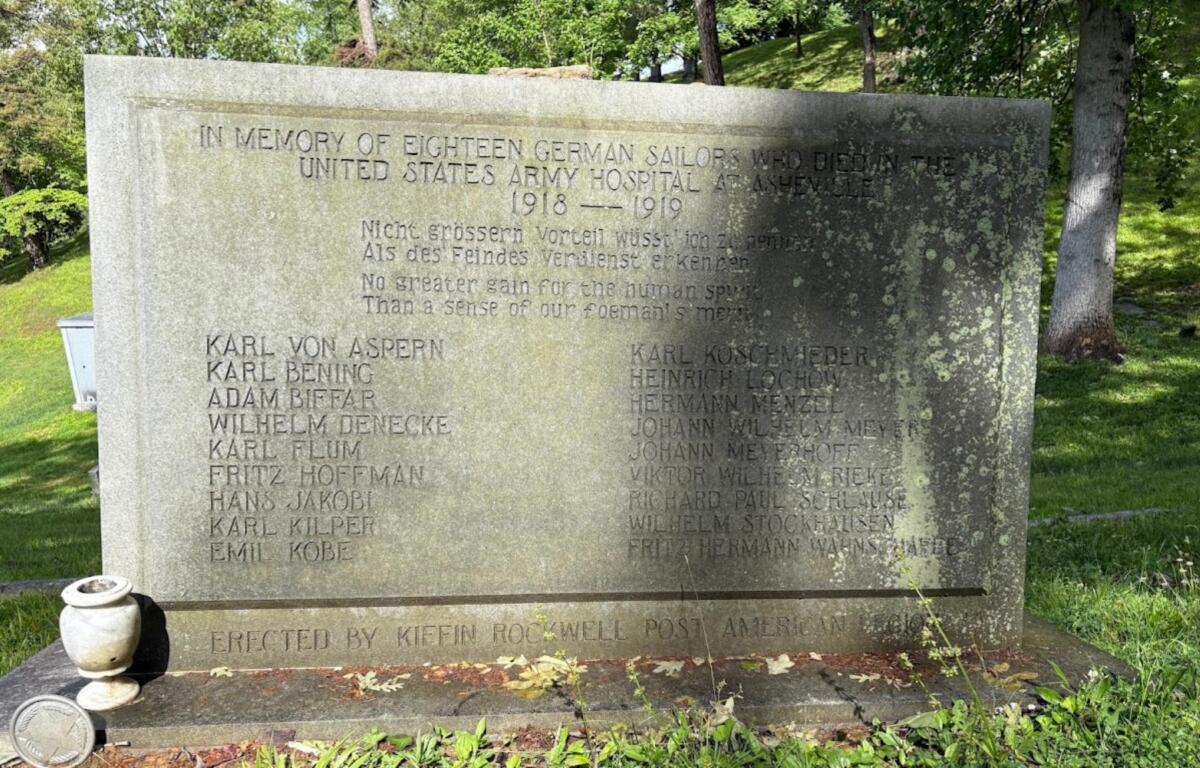
In 1932, a monument at the cemetery was dedicated to the sailors by the Kiffin Rockwell Post of the American Legion. According to news reports at the time, the German ambassador to the United States and several other high-ranking German officials attended.
The monument is a rectangular granite block with lines of poetry from Johann Wolfgang von Goethe inscribed in German and English. The names of the 18 German POWs are listed in two columns beneath the poetry.
Before the monument was erected, the sailors’ graves had not been marked.
“In a spirit of forgiveness from feelings of hatred and anger over German atrocities during World War One the planned monument created enthusiasm in Asheville and support from Washington, DC,” a news report from the time said.
The ceremony, it was reported, was broadcast live by NBC on the radio and was translated and rebroadcast in Germany. Paramount News and Universal Newsreel were on hand to film and make recordings in English and German.
The inscription on the monument reads:
IN MEMORY OF EIGHTEEN GERMAN SAILORS WHO DIED IN THE
UNITED STATES ARMY HOSPITAL AT ASHEVILLE
1918-1919
Nicht größern Vorteil wusst’ ich zu nennen
Als des Feindes Verdienst erkennen
No greater gain for the human spirit
Than a sense of our foeman’s
Names in the left column: Karl Von Aspern, Karl Bening, Adam Biffar, Wilhelm Denecke, Karl Flum, Fritz Hoffman, Hans Jakobi, Karl Kilper, Emil Kobe
Names in the right column: Karl Koschmieder, Heinrich Lochow, Herman Menzel, Johann Wilhelm Meyer, Johann Meyerhoff, Viktor Wilhelm Rieke, Richard Paul Schlause, Wilhelm Stockhausen, Fritz Hermann Wahnschaffe
At the bottom: ERECTED BY KIFFIN ROCKWELL POST AMERICAN LEGION
The American Legion post that sponsored the POW monument was named for Kiffin Rockwell who died in aerial combat in France.